RightShip
How might we redesign a global maritime safety platform that leads to safer vessels, safer crews, and safer seas?
Role
Senior UX/UI Designer
Industry
Maritime
Duration
1 year 3 months

Overview
RightShip operates Qi, a maritime vessel safety SaaS platform used by shipping professionals to vet vessels before chartering. Their existing five-star risk rating model was volatile, opaque, and widely distrusted by the industry it was meant to serve.
PwC partnered with RightShip to redesign the platform from the ground up, rebuilding the scoring model and the product experience at the same time.
The challenge
The redesign had to solve two distinct problems simultaneously.
The first was the rating model itself. A vessel could hold a four-star rating one day and drop to one star after a single minor incident, with no transparency into how the score was calculated or what an operator could do about it. Shipowners were losing charter opportunities based on a number they did not understand and could not meaningfully influence.
RightShip and PwC's data teams rebuilt the scoring system from scratch into a transparent, rules-based Safety Score measuring a five-year window of a vessel's incident, detention, and deficiency history, calculated against its associated fleet, flag, class, and builder. The rebrand from "5-star risk rating model" to "Safety Score" was a deliberate shift in language. One implied a verdict. The other implied accountability.
The second was the product experience. A more credible scoring model still needed an interface that could communicate it clearly, surface the right information to the right users, and support the complex operational workflows maritime professionals depend on every day.

My role
I was the Senior UX/UI Designer on the project, working within a design team alongside a Design Lead and a mid-weight designer, as part of a broader cross-functional program spanning product, engineering, data, change management, and a separate branding agency.
I owned the design of several core pages and features, contributed to the design system and end-to-end prototype, and created journey maps and personas for the three primary user groups: Ship Operators, Charterers, and Vetting Superintendents.

Setting the design foundation
Personas and journey maps
The personas referenced in the project brief were rough outlines. None had been developed to the level needed to inform design decisions. I built them out fully across three user groups, capturing behaviours, needs, and goals for each. The journey maps and personas were validated in workshops with RightShip stakeholders, giving the full team a shared reference point for the work ahead.
Design system
I contributed to building the design system used across the platform, enabling consistent output across all 280+ screens and across team members working in parallel across three workstreams.


Designing the experience
The key insight
The rating model had been built to measure risk. But the people relying on it most needed to understand their own performance and know what they could actually do to improve it. Those are not the same objective. A volatile score with no explanation creates anxiety and erodes trust. A transparent score with clear inputs creates engagement and earns it back. That distinction shaped every design decision that followed.
Safety Score transparency
The vessel detail page was where the new Safety Score lived. The design challenge here was not just showing the number. It was making the number feel earned and explainable. I surfaced the factors behind the score in plain language, directly on the page, so operators could see what was being measured, why their score sat where it did, and what they could actually influence going forward. For an industry that had spent years distrusting the old rating, this transparency was the point.

Vessel and company discovery
The vessel and company landing pages both served users who needed to locate specific records quickly from within large global datasets. The design balanced rich filtering and sorting capability with a clean, scannable interface that did not overwhelm users with options before they had even found what they were looking for.


Inspection and incident workflows
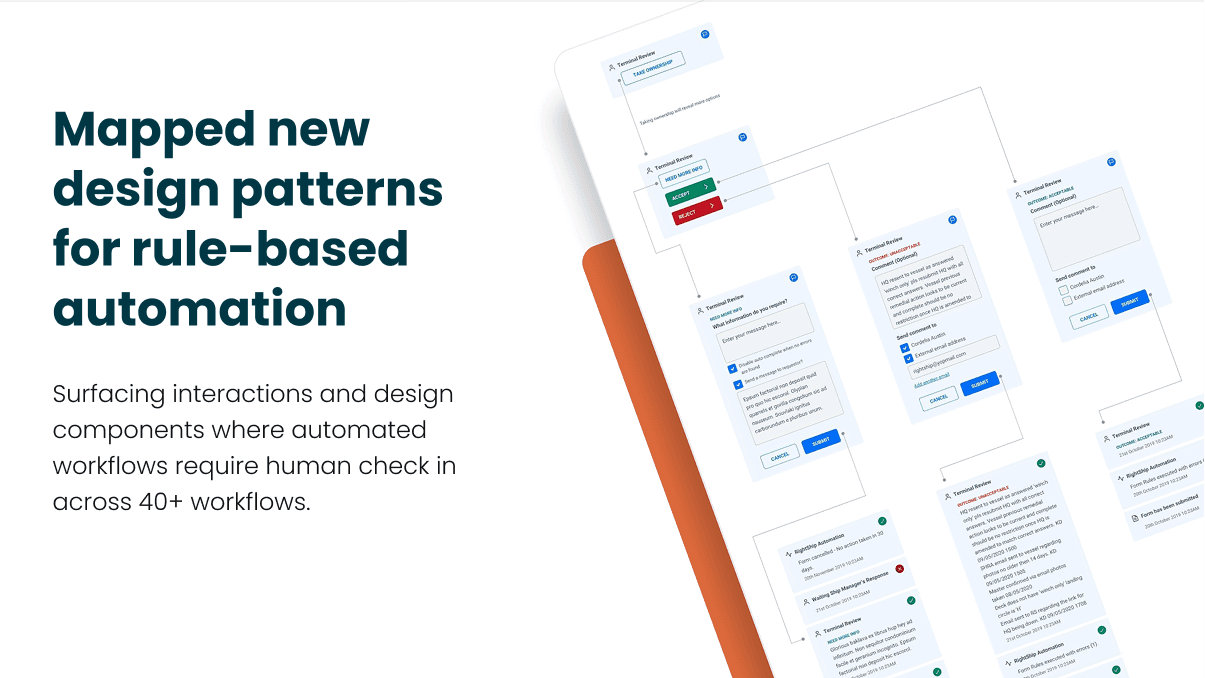
The RightShip Inspection workflow was the most complex feature I worked on. Every inspection carries a status, an audit history, document uploads, a preliminary report, and a final report listing all deficiencies raised by a ship inspector.
Each deficiency must be mapped to a category and sub-category for data accountability, feeding directly into the vessel's Safety Score calculation. Once raised, every deficiency must be addressed, reassessed, and marked as satisfactory before it can be closed.
A built-in communication tool between ship managers and inspectors allowed operators to request further information on specific items, adding another layer of workflow states to manage within the same interface.
The same design challenge ran through all of it: how do you present a large volume of critical, structured information without making it feel overwhelming, while keeping the interface clear enough for a maritime professional under genuine time pressure?

Validation
Usability testing was conducted with 48 participants across 7 global locations, running 10 rounds of group sessions. The Safety Score model went through 41 iterations before reaching its final form, a number that reflects the genuine difficulty of communicating a rules-based system in a way that feels fair, understandable, and actionable to the people it most affects.
"Transparent and more explainable than the current model. I like that the Safety Score is made up of factors that the operator controls." — Ship Operator, RightShip user research
"This is MUCH better. And MUCH faster." — Ship Operator, RightShip user research
Impact
Before
A volatile, opaque five-star rating model that maritime professionals did not trust, could not interpret, and had no meaningful way to influence, undermining RightShip's credibility and creating real financial consequences for shipowners.
After
A transparent, rules-based Safety Score platform launched globally in September 2020, with user feedback confirming the shift in clarity, trust, and explainability the redesign had set out to achieve. The platform launched after 25 sprints across 3 workstreams and went on to serve 12,000+ users globally across 3,000 maritime professionals and 8,000+ subscribers.
280+ screens
across the platform
48
Usability testing participants
7
Global testing locations
500+ hrs
Customer engagement post-launch
The quality of your work was always very good. I think this stems from your patience to listen to the problem and user story to ensure you really understood the issues that we were looking to address with the design. I am amazed how you guys manage to come in completely blind to shipping and RightShip and get up to speed with the business and its workflows and needs. Well done!
Christopher Saunders Global Marine Process Manager / Product Owner RightShip Vetting Platform
Really happy to have had the opportunity to work with Alan. Great person to work with and great talent. Always thinking outside the box and making sure all designs are with the end user in mind. You always brought back the energy in the meetings when we were headed in a brick wall. I really admire how you are able to bring things around and always keep focus on making things as simple as possible.
Other projects

ReturnToWorkSA
How might we rebuild a workplace injury experience with care, clarity, and confidence as its foundation?

RevenueNSW
How might we increase customer confidence and acceptance that a fine was issued correctly?

Victorian Tertiary Admissions Centre
How might we create equity and open opportunities for every student applying for tertiary education in Victoria?