ReturnToWorkSA
How might we rebuild a workplace injury experience with care, clarity, and confidence as its foundation?
Role
Lead Experience Designer
Industry
Social insurance
Duration
1 year 6 months

Overview
ReturnToWorkSA administers workplace injury claims across South Australia. Their existing platform was at end of life, unable to meet data security requirements, falling short of accessibility standards, and struggling to support the operational complexity of managing claims across a large workforce.
I was brought in as lead designer to shape the experience from the ground up, translating complex and often undocumented business logic into a new Salesforce platform while simultaneously redesigning the experience for the people relying on it every day.
The challenge
The first phase had a specific objective: validate that RTWSA's business model, processes, and ways of working could be supported by Salesforce before committing to full build. This was not a migration. It required translating years of complex, often undocumented business logic into a new platform while simultaneously redesigning the experience for employers, injured workers, and case managers.
The broader challenge was building something that could scale. With a multi-year program ahead, the organisation needed design principles, a visual language, and a design system that would give every future sprint a consistent foundation to work from.

My role
I led the UX/UI design stream across an initial one-year engagement, followed by a six-month re-engagement as the program moved from proof of concept into MVP for soft launch.
As the program scaled, I brought on additional design support at key moments. A junior designer joined when deliverable volume increased across the claim types and lodgement flows. A senior designer came on mid-program as workload and sprint pressure grew. I assigned work based on who had the most context for a given workflow and what each sprint required.
Design coherence across all output was maintained through the design system I had established and through daily reviews in Figma, where we set aside dedicated time for work-in-progress checks before moving into focus sessions. Once designs were ready, reviewed and signed off by the Head of Customer Experience, they were presented to the broader business.
Beyond the design team, I worked daily alongside engineers, business analysts, data analysts, change management leads, and cyber security representatives. As the sole design voice in many of those working sessions, my job was not just to produce screens. It was to represent users in rooms where technical, operational, and security priorities were each competing for the same decisions.

Understanding the landscape
Discovery was immersive by necessity. The workflows were too intricate to design from the outside.
I participated in daily three-hour sessions with business analysts working through end-to-end claim lodgement processes alongside insurance agents, mapping how data was entered, how injuries were captured, and how claims progressed through to outcome. Each time a workflow was fully mapped, I moved straight into Figma to translate it into a design.
I also spent a full day shadowing a case manager in live client meetings, first with an employer, then with an injured worker. Watching where the platform failed them, what they tracked manually, and how they improvised to do their job well gave me a grounded understanding that no workshop could replicate. It also changed what I prioritised in the design work that followed.

Setting the design foundation
Brand and visual language
I conducted a brand audit and competitive review of RTWSA's existing assets, identifying where the brand fell short of digital accessibility standards. From this I produced a digital style guide with revised colour ways meeting WCAG 2.1 AA contrast requirements, proposed typography, and a standardised visual language.
This was endorsed by the Head of Customer Experience and the Marketing and Communication team leads, and later incorporated into the RTWSA design system.


UX principles
I led a workshop with RTWSA's Head of Customer Experience and Scyne's Director of Digital to establish five design principles guiding the entire multi-year program: Purposeful, Universal, Unified, Content-led, and Clean. Each came with a definition, a rationale, and practical guidance written for RTWSA's context.
The twelve-page guide was shared across the entire program, giving every designer and developer a shared reference for every decision ahead.


Designing the experience
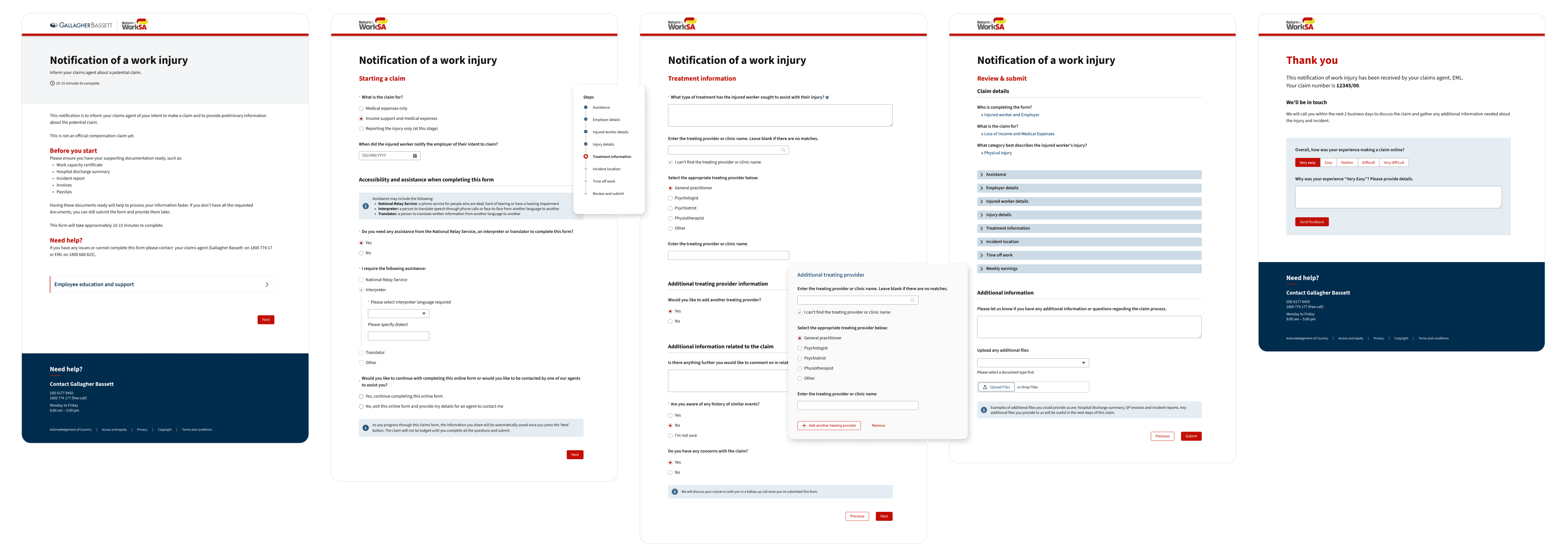
With a junior and senior designer working alongside me across the lodgement flows, the work covered three user groups across more than 345 screens, including desktop, mobile, and email templates. I held creative direction and the quality bar across all outputs, with the design system providing the shared language the team worked within.
Employers
We designed the end-to-end online lodgement experience across three claim types, each with up to four injury sub-types and the ability to lodge up to ten injuries per claim. The work also included the employer portal MyClaims page, allowing employers to return to and complete any open claims.
Injured workers
I designed the mobile injury lodgement form and email-based medical authority approval, prioritising accessibility and clarity for someone who may be in pain, unfamiliar with the process, and anxious about what comes next.
Case managers
The return to work plan had no standardised template to work from. Recovery timelines vary by individual, injury type, and medical advice. The design had to accommodate a progression that could be extended, modified, and endorsed by a medical practitioner at each stage, while keeping case managers, injured workers, employers, service providers, and practitioners connected and in sync throughout. The appointment crowdsourcing feature solved a scheduling problem across three parties within a three to five business day window, built in close collaboration with engineering to confirm the time slot logic was technically buildable.
Two decisions that changed direction
The first resolved an ongoing internal debate about co-branding on lodgement forms. I designed a consistent approach placing RTWSA and insurance company logos together at the top of each form, with the insurance company's contact details surfaced for assistance, and produced guidelines for when co-branding applied versus when RTWSA branding should stand alone.
The second was restructuring what users encountered before the form even started. Expectation-setting content had been embedded inside the application itself, and personal details already held in the system were being re-entered manually. Moving that content outside the form and automating data pre-fill reduced both the actual and perceived length of the process. Both decisions were endorsed by the Head of Customer Experience before implementation.

Validation
I ran user testing with 7 injured workers and 4 employers across the end-to-end lodgement form. I led the opening sessions with the team co-facilitating and observing, then rotated facilitation so both designers built confidence running sessions themselves.
The experience largely validated expectations. The feedback that came back consistently was about language: too formal, too clinical, and unclear about who was actually contacting the user. Copy changes were approved by RTWSA and the tech leads and implemented in the following sprints.


Impact
Before:
Case managers working around a platform at end of life. Employers and injured workers navigating a claims process with no clear guidance, inconsistent experiences, and no shared design direction across the organisation.
After:
A proof of concept endorsed by the Chief Digital and Information Officer. A design system and five UX principles providing a scalable foundation for a multi-year program. More than 345 screens across three user groups. A team of designers directed through a complex, high-pressure engagement. And a re-engagement that confirmed the work had earned the next phase, moving the program into MVP for soft launch.
20% reduction
lodging claim
1.5x faster
processing claim
10 hrs saved
assessing claim
CDO endorsed
proof of concept
"I can't say just one thing because you were amazing at so many things: communication, listening, getting the work completed in such a quick turnaround time. You are so talented and such a pleasure to work with."
— Katelynd Williams, Insurance Agent Representative, RTWSA Digital Transformation Program
"Communication has been excellent, well beyond what I've experienced with other consultants in the past. Quality is very good. Your artefacts are clear and polished. Keep the pace you're working at. Things can move quite slowly at RTWSA so this has been refreshing."
Other projects

RightShip
How might we redesign a global maritime safety platform that leads to safer vessels, safer crews, and safer seas?

RevenueNSW
How might we increase customer confidence and acceptance that a fine was issued correctly?

Victorian Tertiary Admissions Centre
How might we create equity and open opportunities for every student applying for tertiary education in Victoria?